

A 30% increase across one maker’s MLCC portfolio took effect August 1, the latest in a year of hikes after Murata in April and Yageo in July, with a second major maker following September 1. The tightest supply is in the high-capacitance, high-reliability grades used in medical, aerospace, military, and industrial builds. If you have capacitors on an active bill of materials, your quotes are already moving. Here is what actually changed and what it means for how you source.
Why did capacitor prices go up so fast?
Two reasons, and both matter for whether this reverses:
- Raw materials. The metals and powders inside a multilayer ceramic capacitor, including nickel and specialized ceramic powders, have climbed over the past year. When the input cost rises, the part cost follows, and it does not fall back just because a quarter ends.
- Where the capacity is going. AI server demand for high-grade capacitors is enormous. A single AI server cabinet can use hundreds of thousands of MLCCs, many times what a standard server needs. To serve that demand, makers are converting production lines away from general-purpose parts toward the high-grade specifications AI systems require. That leaves less floating supply for everyone buying the ordinary parts, which is most of the market.
Why is this different from a normal shortage?
Because the supply is being reserved before it is made.
The major makers are moving capacity onto long-term agreements, multi-year contracts where a large buyer locks in volume and price years ahead. Industry reporting puts delivery on some of these agreements locked out through 2027. When most of the output is committed under contract, the open market stops being where the extra supply goes. It becomes the only door left for buyers who are not on one of those contracts.
For a procurement team, that is the real shift. A normal shortage is a volume problem that ends when capacity catches up. A contractual lockup is an access problem, and it does not end on a schedule you can see.
Strong sales now mean tighter supply later
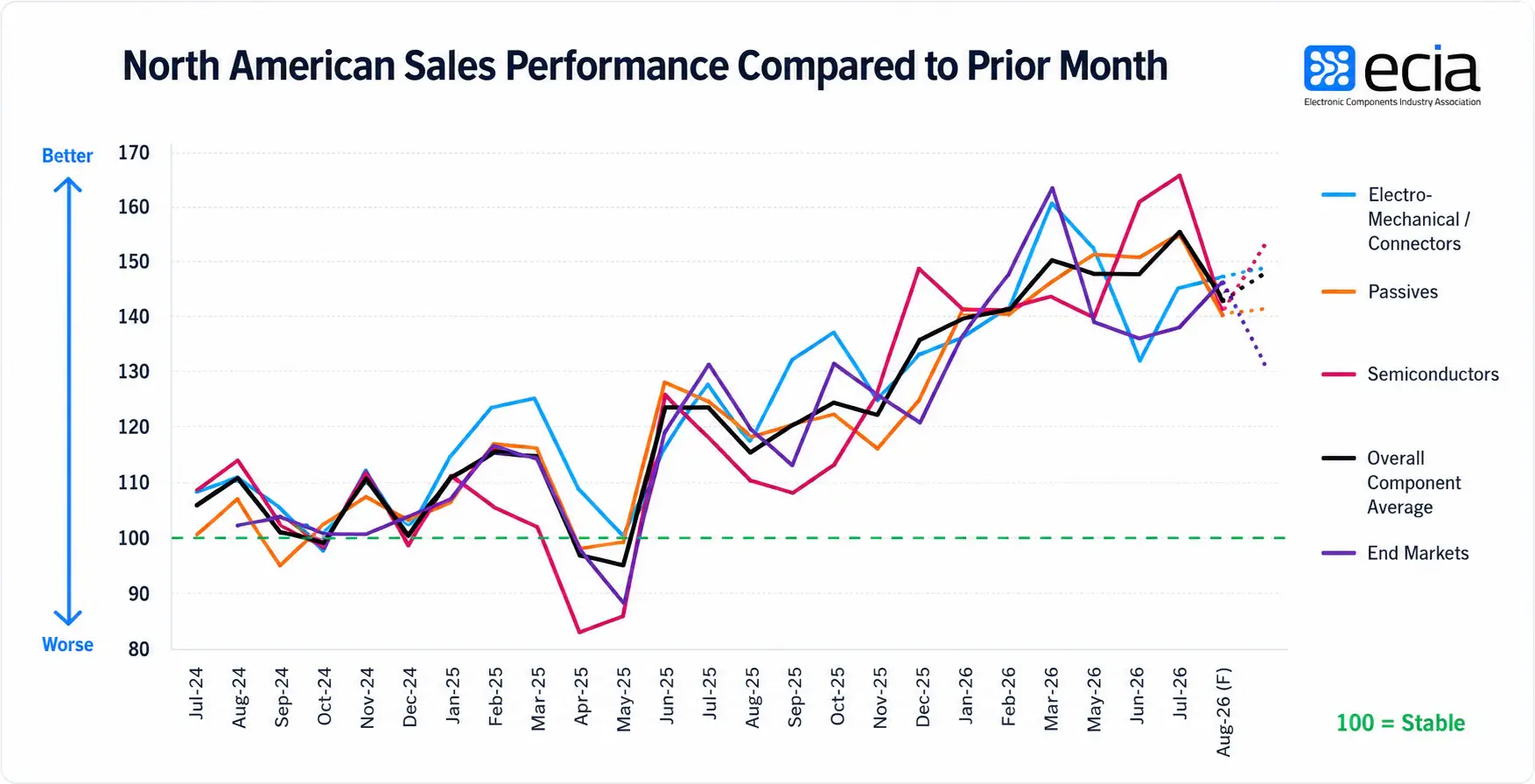
North American electronic component sales are still running well above normal. July’s sales index came in at 141.6, off June’s five-year high but still more than 40 points above the level that signals a stable, balanced market. Demand has now sat this far above normal for over a year.
That strength is good news for component manufacturers. For the people buying those components it cuts the other way. When demand stays this high while supply stays tight, the gap shows up as longer lead times, allocation, and shortages that keep building for contract manufacturers and OEMs. The July dip does not change that. It is a small step back from a record, not a return to normal.
See ECIA’s full July sales report
What should buyers do right now?
A few practical moves.
- Treat quotes as short-lived. When channel inventory is under 30 days and spot prices are moving two to three times normal, a quote from last week may not hold. Confirm current pricing and availability before you commit a build.
- Widen your qualified sources before you are forced to. Under schedule pressure, buyers pushed off the authorized channel often end up sourcing from unfamiliar vendors in a hurry. Doing that qualification calmly, ahead of the crunch, is far safer than doing it the week a line is about to go down.
- Know where each part actually came from. This is the part that gets skipped when everyone is scrambling, and it is the part that matters most.
Where the counterfeit risk comes in
Here is the honest version, without overstating it. Scarcity does not automatically create counterfeit parts. What scarcity does is change two things: where buyers source, and how much verification they feel they can skip under a deadline. A price shock, no guaranteed delivery from the authorized channel, and a sudden move toward unfamiliar suppliers are exactly the conditions where an unverified part can slip into a legitimate build.
That is the whole reason verification exists. At AERI, every part runs through our in-house QC lab, with inspection and testing to recognized industry standards, before it ships. We have sourced obsolete, allocated, and hard-to-find components since 1994, and the point of the lab is simple: when the market pushes you toward sources you do not know, you should not have to take the part’s history on faith.
AERI was founded by Robb Hammond, a founding member and former committee chair of the SAE AS6081 standard, created for the avoidance of counterfeit electronic components.
If capacitors on your BOM are getting hard to quote or hard to get, we can help you source them and verify them.
How AERI prevents counterfeit components →
Can’t find the part? We can.
AERI sources hard-to-find and obsolete components and tests every lot for authenticity before it ships. Send your list for a fast quote.
FAQ
How much did MLCC prices rise in 2026? Prices rose in several waves. Murata raised 15 to 35 percent in April, Yageo about 50 percent in July, and a leading maker raised 30 percent across its MLCC portfolio effective August 1, with a second major maker following September 1.
Which capacitor grades are hit the hardest? The 30 percent list increase was broad, but the real availability crunch and the biggest spot-price jumps are in high-capacitance, high-reliability grades, the kind used in medical, aerospace, military, and industrial equipment. Standard commodity parts remain more available.
Will capacitor prices come back down soon? Not likely in the near term. The increase is driven by rising raw-material costs and by production capacity being reserved under long-term agreements, some locked out through 2027. New high-grade capacity takes 18 to 24 months to come online.
What can I do if I cannot get the capacitors I need? Confirm current pricing before committing a build, qualify additional sources ahead of the crunch rather than during it, and verify the provenance and quality of any part sourced from a new supplier. AERI can source and test hard-to-find components through its in-house QC lab.
