How can manufacturers make sure they are not getting counterfeit electronic components?
A working guide for supply chain managers, procurement engineers, and quality leaders at OEMs and subcontractors in mil-aero, medical, industrial, and other long-life-cycle programs that use electronic components.
Author: Robb Hammond, founder of AERI. Founding member and former committee chair of the SAE AS6081 Standard created for the avoidance of counterfeit electronic components.
Last updated: June 2026
The short answer
You prevent counterfeit electronic components by removing the points in your supply chain where nobody is looking. Inside your own walls, that means creating a bulletproof procedure that will make absolutely sure that your organization only uses an approved vendor list with real qualification criteria. When shortages force you to the open market, it means buying only through an independent distributor that is AS6081 compliant, tests to AS6171-aligned methods matched to your application's risk level, and hands you an evidence-grade testing report. This guide walks through each layer and even offers you a counterfeit avoidance quality document you can plug right into your own quality system.
The problem: what one counterfeit can do to your production line
If you manage supply chain for a manufacturer building anything that has to keep working in the field, medical devices, aerospace systems, military hardware, or industrial equipment with a long deployed life, the question you are asking is not abstract. You have probably already had a near-miss. Maybe a part came in that did not behave the way the datasheet said it would. Maybe a board failed a test at final assembly and the root cause traced back to a single chip. Maybe an OEM you trusted got sourced into a corner and pulled from the open market without telling you.
Counterfeit electronic components have been an industry-wide problem for more than two decades, and the problem has grown sharper since 2022. The AI memory boom is the dominant force right now. Manufacturers are pouring capacity into high-bandwidth memory for AI servers, starving the rest of the market of DRAM and SRAM. Lead times that used to be 4 to 6 weeks are stretching past 20 weeks for parts going into medical, aerospace, military, and industrial programs. When buyers cannot find a part through authorized channels, they go to the open market. When they go to the open market without a qualified independent distributor, they get whatever the open market hands them. None of this is new, only sharper. A two-year U.S. Senate Armed Services Committee investigation documented roughly 1,800 cases of suspect counterfeit electronic parts in the defense supply chain, involving more than one million individual components, and that was in 2012, two shortage cycles ago.1
The counterfeit cycle: from scrap heap to your receiving dock
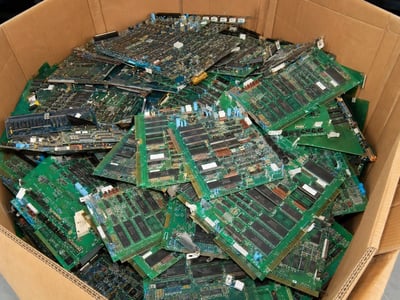
STEP 01
Scrap boards exported
Discarded circuit boards are exported as scrap, often labeled as working equipment, to overseas markets.
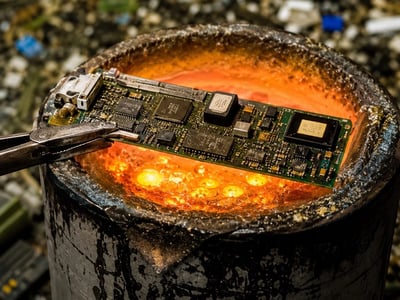
STEP 02
Components removed and sorted
Boards are heated over open flame to melt the solder, and every reusable chip is stripped off by hand.
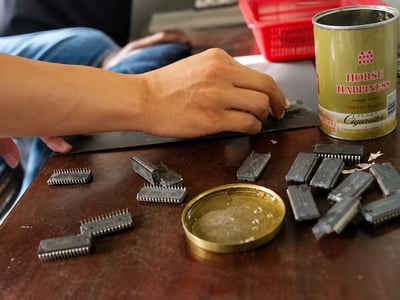
STEP 03
Refinished and resold
Surfaces are sanded, parts are re-marked with new date codes and part numbers, and the components are sold as new.
The cost of one counterfeit slipping through is rarely just the price of the part. The pattern we see across the industry consistently includes some combination of: a field failure that scrubs a launch window, a recall that runs into seven figures, a damaged relationship with a prime contractor, a corrective-action audit that exposes process gaps the manufacturer did not know they had, and on the military side, a non-conformance report that can end a contract.
This guide is written for the supply chain manager. You are the person in your organization who decides which suppliers your company is allowed to use, and you are the one who carries the risk when a part fails. The framework here works whether you buy from AERI or from one of our competitors. The point is that you should be buying from someone who treats this seriously, and you should know how to tell the difference.
A note on the author. Robb Hammond founded AERI in Costa Mesa, California in 1994 and has run it for 32 years. He is a founding member and former chair of the SAE AS6081 standard committee, the body that wrote the international standard for how independent distributors qualify suppliers and test electronic components for counterfeit risk. He has served on the SAE committee through the in-flight transition that is moving counterfeit testing methodology from AS6081 into AS6171. Nothing in this guide is theoretical for him.
What systems should you have in place inside your own quality system?
The first line of defense is your own quality system. Before you start qualifying brokers, take an honest look at what happens inside your four walls when a part arrives. Most counterfeit incidents the industry tracks share a common thread: at some point in the chain, no one was looking for a counterfeit. The systems below close that gap.
Receiving inspection that goes beyond a packing slip
When a component arrives, the first inspection should compare what is on the box to what is inside the bag. Date codes, lot codes, country of origin, package markings, and reel labels should all match the documentation you were promised. This is not a trust exercise. Counterfeiters rely on receiving departments that visually verify quantity and nothing else.
A documented chain of custody for every lot
If a procurement engineer cannot trace a specific reel back to a specific purchase order, a specific vendor, and a specific certificate of conformance within five minutes, your chain of custody is not actually documented, it is institutional memory. Institutional memory leaves when people leave.
A maintained approved vendor list with criteria, not just names
An AVL that lists vendors without spelling out how they were qualified is a vulnerability. The right structure is: vendor name, qualification date, the standards they are compliant with, last audit date, last issue (if any), and a re-qualification cadence. AS9100-certified manufacturers in aerospace already have a version of this. If you do not, build one.
A named escalation path when a part is suspect
Who in your organization has authority to quarantine a lot? Who decides whether to send a sample out for forensic testing? Who calls the broker? These should be named roles with documented procedures, not informal conversations that depend on who happens to be in the building.
Cross-functional ownership between quality and procurement
Counterfeits get through when procurement is measured on price and quality is measured on defect catches, and the two functions do not talk to each other. The strongest manufacturers we work with run a joint quality and procurement review on any new vendor, any open-market source, and any part that came in below the expected market price.
Periodic internal audits, not just reactive ones
If you only inspect parts when something has already gone wrong, you are learning from failure. The better posture is to run all products purchased from the open market through a deeper inspection process. Most incidents we see at the broker level could have been caught at the receiving dock if someone had been looking.
How do you qualify an independent distributor or broker?
When the part you need is not available through authorized channels, and right now, for a meaningful percentage of components going into industrial, medical, aerospace, and defense programs, it is not, you will end up working with an independent distributor. The question is which one.
The criteria below are what we would tell a supply chain manager to look for in any independent distributor, including ours. If a broker cannot answer "yes" to most of these, the risk profile is high enough to source elsewhere.
Is the distributor AS6081 certified?
AS6081 is the SAE standard that governs how independent distributors qualify suppliers, inspect incoming parts, test for counterfeit indicators, and document the entire supply chain. Compliance is auditable. Ask to see the audit report, not just a logo on a website.
Do they use AS6171-aligned methods?
AS6171 is the testing-methodology standard that is replacing the testing-specific portions of AS6081. A serious distributor either holds AS6171 accreditation directly, partners with an AS6171-accredited lab, or uses AS6171-aligned methods under their own quality system. Ask the question explicitly. Section 4 of this guide explains AS6171 in detail.
Are they a member of IDEA?
The Independent Distributors of Electronics Association is THE industry trade body for the independent distribution market. IDEA membership is not a credential by itself, but it is a baseline filter. Members agree to a code of ethics, undergo annual audits, and have access to IDEA training and inspector certification programs.
Do they have IDEA-ICE-3000 certified inspectors on staff?
IDEA-ICE-3000 is the inspector certification for counterfeit-component detection. An ICE-3000 inspector has at least six months in the industry, deep knowledge of IDEA-STD-1010, which is the most accepted quality standard in the industry, and has passed a multi-hour exam. Certification requires a re-qualification exam every two years. Ask how many ICE-3000 inspectors the distributor has on staff. Ask to see the certifications.
Do they run an in-house lab, or do they outsource testing?
This matters more than most buyers realize. Many independent distributors do basic visual inspection in-house and then ship parts to a third-party test house when something looks off. That adds at least a week per lot, sometimes more, because your parts wait in an outside queue and then have to ship back before anyone can clear them. When external labs back up during shortage cycles, that wait stretches further, and you do not control it. A distributor with its own lab completes Level 1 testing in days. The weeks saved are not a marketing point. They are the difference between hitting your build schedule or explaining a delay to your customer.
Are they AS9120 certified?
AS9120 is the aerospace quality standard for distributors. If you are sourcing for an aerospace or defense program, AS9120 is not optional. If you are not sourcing for aerospace, it is still a meaningful signal that the distributor has built a quality system that can survive an external audit.
Are they ESD S20.20 compliant?
Electrostatic discharge damage is invisible until it is not. A distributor without a documented ESD program is moving parts through their facility in a way that can degrade them before they ever reach you.
Are they on the QTSL?
The Department of Defense Qualified Testing Suppliers List means the Defense Logistics Agency has audited the distributor and approved them as a supplier for military programs. It is one of the highest-bar credentials available to an independent distributor.
Will they let you visit?
A distributor that will not host a customer audit, even a short one, is telling you something. The ones worth working with welcome the visit. Ask to see the lab, the inspection area, the receiving dock, and the document storage. You will learn more in two hours on-site than in any sales call.
What is their disclosure posture on refurbs, reballing, and retinning?
The industry has parts that have been pulled from old boards, cleaned, reballed, and resold. Sometimes this is legitimate, when the buyer has been told and the testing has been done. Sometimes it is not. Ask the broker directly: when was the last time you encountered a refurbished part, and what did you tell the customer? Their answer tells you their posture.
Red flags worth treating as deal-breakers: pricing that is meaningfully below market with no explanation, a refusal to provide a certificate of conformance, vague or evasive answers about where the lot came from, and pressure to skip extended testing because "we already checked it."
What do AS6081, AS6171, and IDEA-STD-1010 actually cover?
The three standards that matter most for counterfeit prevention in independent distribution are AS6081, AS6171, and IDEA-STD-1010. They are sometimes confused with each other. The differences matter because they tell you what your broker is actually doing.
A note on SAE. SAE International (originally the Society of Automotive Engineers) is the standards body responsible for AS6081 and AS6171. The name is misleading. SAE writes standards across many industries and is heavily involved in aerospace and defense. AS6081 and AS6171 are written by joint committees that include both government (Department of Defense, NASA, FAA) and industry (Boeing, Lockheed Martin, prime contractors, and qualified independent distributors). A standard authored jointly by the customers and the suppliers carries more authority than one authored by an industry trade group alone. That joint authorship is the reason SAE standards are accepted across mil-aero programs in a way that purely industry-authored standards are not.
AS6081: the governance and process standard
AS6081 defines what an independent distributor's quality system must look like in order to manage counterfeit risk. It covers supplier qualification, incoming inspection, testing requirements, documentation, escalation, and reporting. The first version was published in 2012. Robb is a founding member and for a time was the chair.
As of 2026, the testing-method portions of AS6081 are migrating to AS6171. After the transition, AS6081 will govern how a broker runs (vendor handling, paperwork, bad-parts reporting, the governance and process side) while AS6171 will own the testing methodology. The testing language has been removed from the latest revision of the AS6081, but many manufacturers are still using the test parameters for their counterfeit avoidance requirements because it was so effective. If a broker tells you they are "AS6081 compliant," the right follow-up question is whether they are also testing to AS6171, because that is where the technical testing requirements now live.
AS6171: the electronic components testing-methodology standard
AS6171 is published as a parent document with 11 "slash sheets," each one covering a specific test method. The methods include external visual inspection, x-ray, x-ray fluorescence (XRF), decapsulation, radiological inspection, scanning acoustic microscopy, FTIR (Fourier-transform infrared spectroscopy), TGA (thermogravimetric analysis), and electrical testing, with the specific list maintained by the SAE committee. Each slash sheet tests for a specific class of counterfeit indicator.
AS6171 is risk-based by design. A documented risk assessment assigns each application a risk level, and the risk level dictates which combination of slash sheets to run and how rigorously. At the top of the scale sit mil-aero applications where a part failure costs lives or programs; at the bottom, commercial applications where a failure is recoverable.
Critical to understand: no one runs all 11 slash sheets on a single part. Robb's estimate, working from the committee side, is that doing every test on one part could approach $100,000. AS6171 is designed as a risk-level-driven menu. The supply chain manager, working with their engineers, decides which slash sheets the application actually requires. A serious independent distributor will tell you what risk level they are testing to, why they chose it for your application, and what the cost implication is. A less-serious distributor will quote you a flat "extended testing" line item and not explain the methodology.
IDEA-STD-1010: the receiving and inspection baseline
IDEA-STD-1010 is the open-market receiving and inspection standard published by the Independent Distributors of Electronics Association. It predates AS6081 and is narrower in scope: it focuses primarily on visual and mechanical inspection at the receiving stage, with some testing guidance. It is industry-authored. The original committee did not include government or aerospace seats, which is why IDEA-STD-1010 works well as a commercial baseline but is not, on its own, sufficient for government and aerospace buyers who require the joint-authorship credibility of SAE standards.
A simple way to think about how the three standards relate: IDEA-STD-1010 is the inspection floor, AS6081 is the system around the inspection, and AS6171 is the laboratory testing that confirms what the inspection suspected.
The three standards at a glance:
Standard
What it governs
The question to ask your distributor
AS6081
The distributor's quality system: supplier qualification, incoming inspection, documentation, escalation, and reporting
"Are you AS6081 certified, and can I see the audit report?"
AS6171
Laboratory test methods and risk-based test selection, published as a parent standard with 11 slash sheets
"What risk level are you testing my parts to, and which methods does that include?"
IDEA-STD-1010
The visual and mechanical receiving-inspection baseline for open-market parts
"Are your inspectors IDEA-ICE-3000 certified to this standard?"
Why the AS6081 to AS6171 migration matters to your AVL
If your approved vendor list was built three or four years ago and you qualified vendors on "AS6081 compliance" alone, you are due for a review. The right standard today is AS6081 plus AS6171, and the right question to ask each vendor is whether their testing has migrated to AS6171 risk-level methodology, either directly or through an accredited partner lab. Vendors who cannot answer that question with specifics are likely behind the curve.
What should an extended testing report contain?
Once a lot has been tested, you should receive an extended testing report. The report is the evidence file. If you ever need to defend a procurement decision in an audit, a recall investigation, or a contractual dispute, the testing report is what you produce. Standard QC reports are typically brief and included with normal inspection. Extended reports, the ones built for elevated risk or mil-aero applications, can run up to roughly 50 pages with photographs and supporting documentation.
Here is what an extended testing report should contain, regardless of which distributor produced it.
Identification
The report should identify the part number, manufacturer, date code, lot code, quantity, and the purchase order under which the lot was received. This connects the testing record to your procurement record.
External visual inspection
Photographs of the package from multiple angles. The marking, the pin one indicator, the package corners, the leads or balls, and the topside molding compound. The photos should be high enough resolution that surface texture is visible. Counterfeiters often resurface and remark parts, and the remarking is visible under proper lighting.
X-ray imaging
X-ray penetrates the package and shows the die and the lead frame inside. The die should match the size and position of a known authentic part. Internal void patterns, wire bond layout, and die orientation are all signals. X-ray is one of the most useful single tests for counterfeit detection on most package types.
X-ray fluorescence (XRF)
XRF identifies the elemental composition of the lead finish. Counterfeiters who have re-tinned a lead (re-coated the legs with fresh solder) often use a different alloy than the original manufacturer specified. XRF catches this.
Decapsulation photos
For higher-risk applications, the lab will chemically remove the molding compound and photograph the die directly. The die markings, the bond wires, and the die size should match the manufacturer's reference. AS6171 protocols typically decapsulate three pieces per lot. Mid-tier testing programs, like our trademarked AuthentiPro, typically decapsulate one piece per lot. This is destructive testing on a sample, not on the whole lot.
Microscopy
High-magnification images of the leads, the package corners, and any suspected rework. Standard inspection microscopy runs at 30 to 70 times magnification. The microscopy file should show whether tooling marks, indentations, or surface damage are present that would indicate a part has been pulled from a previous board.
Electrical test or curve trace
The part should respond to electrical stimulus the way the datasheet specifies. Curve trace is a quick electrical check that can identify shorts, opens, and out-of-spec behavior without a full functional test, and it is one of the highest signal-to-effort tests in the standard menu.
Scrape and acetone tests
Mechanical and chemical tests for surface coatings that should not be there. If the black plastic surface comes off under acetone, the part has had an extra layer of paint to hide old part markings and blemishes. This is a fast, low-cost, and decisive test for blacktopped counterfeits.
Documentation records
The certificate of conformance, the supplier traceability record, the IDEA-ICE-3000 inspector's signed report, and the date of testing.
A clear pass or fail determination, with criteria
The report should state explicitly what risk level it was tested to, what the pass criteria were, and what the outcome was. Vague language like "appears to be authentic" is not a passing determination. The report should commit.
If your distributor's report is missing any of these elements and you are sourcing for a critical application, ask why. There are legitimate reasons some elements may be omitted for lower-risk applications, but the distributor should be able to explain the omission and tie it to the AS6171 risk level the test plan was built around.
How does AERI implement all of this?
This section explains how we actually do the work. It is not a sales pitch. It is the implementation pattern that comes out of 32 years of running an independent distributor and over a decade of standards work at SAE.
The lab is in-house
Most independent brokers do basic visual inspection in-house and ship parts to a third-party test house when something looks off. We built our own lab so we do not have to do that for most of what we test. The reason is the same reason the best independent coffee roasters refuse to franchise. Crema Coffee is one of the top-rated roasters in the country and has deliberately stayed small because quality would suffer if they added locations. Robb sees AERI the same way. When the work is core to what you sell, you control it.
There are exceptions. We still route certain tests through external labs when a customer contractually requires it, or when a specific test sits outside what we run in-house. AuthentiPro is our proprietary service we most often use for in-house level-2 testing. If we need to send product out we will tell you exactly where a given lot is being tested, in-house or routed, in the quote.
Three tiers of testing
Customers choose the tier that matches their application. We document the choice. The three tiers are:
Level 1: IDEA-STD-1010 inspection
Our baseline offering. In-house. Visual inspection, scrape test, blacktop checks, documentation. This is the right tier for commercial applications where a part failure is recoverable. It does not include decapsulation, x-ray, or XRF.
Level 2: AuthentiPro
Our mid-tier offering. Robb's framing with customers is "this is what we think you need." AuthentiPro adds X-Ray, XRF, decapsulation, and the standard microscope inspection at 30 to 70 times magnification, acetone and scrape tests that are included in the Level 1 baseline. It catches most counterfeits without running the full government-grade test menu.
Level 3: AS6081 plus AS6171 protocols
Premium, mil-aero-grade, government-and-aerospace accepted. The specific tests are selected from AS6171's 11 slash sheets based on the customer's risk level (per the standard's risk-level methodology). Decapsulation here is typically three pieces per lot rather than AuthentiPro's one. AERI uses AS6171-aligned methods today and is on a path to AS6171 accreditation. For applications that require an AS6171-accredited test house signature on the report, we partner with accredited labs to route those specific tests, and we are transparent with the customer about which tests are run where.
Beyond the three tiers, customers can specify custom protocols when their application sits outside the standard menu. We have built those for aerospace customers running parts the standard slash sheets do not fully cover.
Standards leadership at the source
Robb is a founding member and previous chair of the AS6081 committee. He contributed to the SAE committee that developed AS6171. The standards are not theory at AERI. They are something he helped write, and the people in his committee role can call him on anything that does not match what is in the document. That accountability is part of why we will not overclaim on capabilities we do not yet hold.
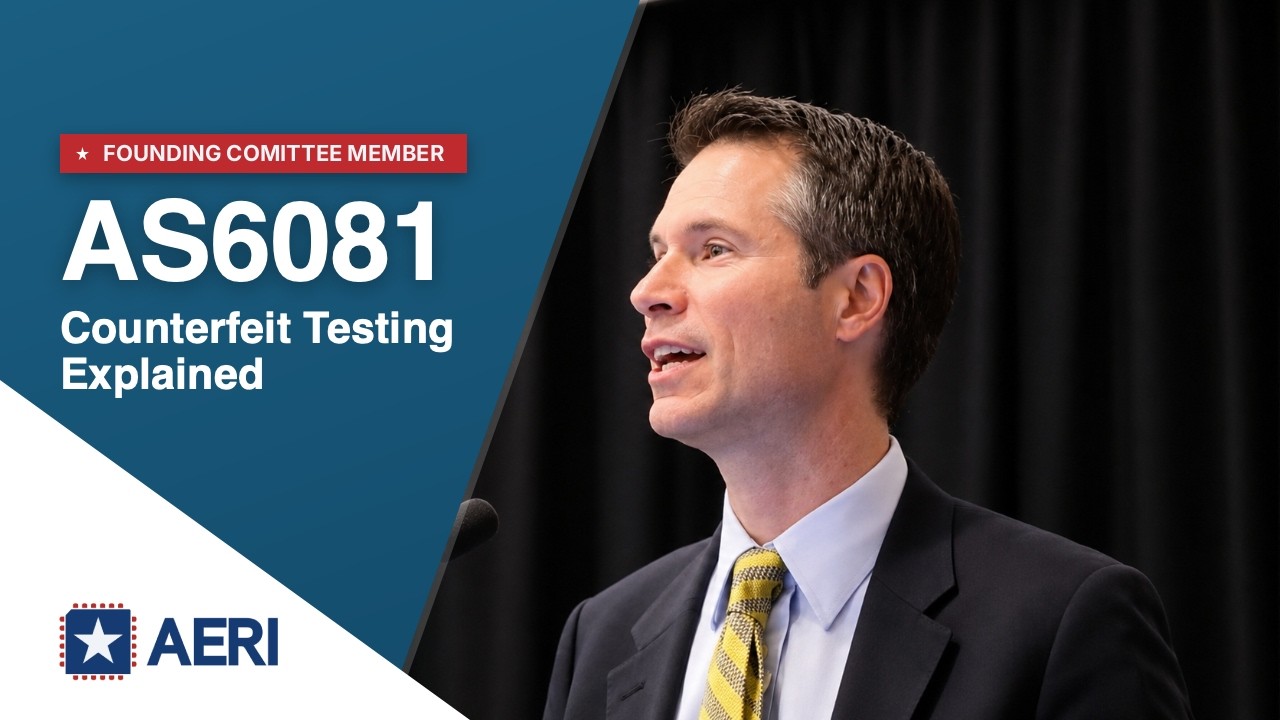
Robb Hammond presenting on AS6081 counterfeit-component testing at the 2015 SMTA/CALCE Symposium on Counterfeit Parts and Materials, University of Maryland.
Inspector certifications
Our inspectors hold IDEA-ICE-3000 certification, the industry standard for counterfeit-component detection inspectors. ICE-3000 requires at least six months in the industry, deep knowledge of IDEA-STD-1010, and a multi-hour recertification exam every two years. Customers can ask to see the credentials. We provide them.
Full certifications stack
Credential
What it covers
Verified by
AS9120
Aerospace distribution quality system
External audit
ESD S20.20
Electrostatic discharge control program
National Quality Assurance USA
QTSL
Department of Defense Qualified Testing Suppliers List
DLA Land and Maritime, Cage Code 08YR5
AS6081 certification
Counterfeit-avoidance governance and process
Auditable to the SAE standard
IDEA membership
Industry association code of ethics
Annual audits
IDEA-ICE-3000
Counterfeit-detection inspectors on staff
Recertification exam every two years
AS9120 plus QTSL together is what makes us a fit for mil-aero subcontractor work in particular.
Operational details that almost never make it into marketing
On dry days, we control humidity in the QC area. Static electricity can damage parts before any test ever runs. It is a small detail. We mention it because it is the operational truth of how the lab actually runs, and the same kind of detail tends to be missing at brokers who treat testing as a checkbox.
Our RMA rate, our return-for-defect rate from customers, is similar to authorized distributors. Authorized distributors are the gold standard for parts integrity because they buy directly from the component manufacturers. Matching that benchmark while sourcing from the open market is the operational standard we hold ourselves to.
Case files we have caught
Counterfeits arrive in known patterns. Black-topped parts where the original marking has been sanded off, repainted, and remarked. Heated-over-tin-can parts, pulled from old boards by counterfeiters who heat the boards on a tin can to release the components, then sand the leads and remark them. Reballed and retinned parts pulled from previous boards, re-prepared, and shipped without disclosure. For a closer look at how these patterns are identified during inspection, see our guide on how to detect counterfeit electronic components. Robb has video work documenting several of these in detail, and we share annotated case files with customers on request.
David Millet, one of our senior salespeople, has a line he uses with customers in mil-aero accounts: "If we can't find it, you don't want it." The line works because the work behind it is real. The lab is here. Robb led the AS6081 committee and helped write the standards. The inspectors are certified. Whether you end up working with us or with another qualified independent distributor, the same statement should be true.
Common questions about counterfeit electronic components
What is a counterfeit electronic component?
A counterfeit electronic component is a part whose identity, origin, or condition has been misrepresented. That covers parts remarked with a false part number, date code, or manufacturer logo, used parts harvested from scrap boards and sold as new, parts that failed the manufacturer's testing and re-entered the market, and unauthorized copies. The misrepresentation is the defining feature, not the part's condition alone. Our counterfeit detection guide explains how each of these types is identified in the lab.
How do counterfeit parts enter the supply chain?
Almost always through the open market during shortages and obsolescence. When authorized channels run dry, buyers turn to brokers, and unvetted brokers pass the problem down the chain: harvested e-waste, remarked date codes, refurbished parts without disclosure. The entry point is nearly always a purchasing decision made under schedule pressure without a qualified independent distributor in between.
What is the difference between AS6081 and AS6171?
AS6081 governs the independent distributor's process: supplier qualification, incoming inspection, documentation, and reporting. AS6171 governs the laboratory testing itself, through a parent standard and slash sheets covering individual test methods, selected by risk level. Think of AS6081 as the system and AS6171 as the lab work inside it.
How much does counterfeit component testing cost?
It scales with risk. Baseline visual inspection to IDEA-STD-1010 is included in a serious distributor's standard process. Mid-tier programs that add XRF, decapsulation, and microscopy carry a per-lot charge. Full AS6171 protocols are priced by the slash sheets your risk level requires; running every method on a single part could approach six figures, which is why the standard is built as a risk-based menu rather than a checklist.
How long does counterfeit testing take?
In-house, days. Outsourced, weeks. A distributor with its own lab can typically turn baseline inspection and mid-tier testing in days, while brokers that route lots to third-party test houses are subject to those labs' queues, which are currently running multiple weeks.
Are refurbished or reballed parts always counterfeit?
No. A refurbished part sold with full disclosure and appropriate testing can be a legitimate, sometimes necessary option for obsolete components. The same part sold as new without disclosure is counterfeit. Disclosure is the line, and it is the first thing to probe when a price looks too good.
Where do you go from here?
If the framework in this guide is useful, the Independent Distributor Purchasing Policy turns it into a document you can adopt straight into your own quality system. It is a ready-to-use policy template that sets the bar an independent distributor must clear before you buy from them: the quality certifications they should hold, minimum warranty and insurance terms, a documented counterfeit-mitigation and parts-control plan, supplier approval and source-selection criteria, and the verification and testing each lot should receive, with a report on every shipment. Adopt it as written or adapt it to your program.
Download the Independent Distributor Purchasing Policy
If you would rather start with a conversation, you can reach Robb directly through our contact page. Whether you end up working with AERI or not, the goal of this guide is the same: fewer counterfeits in the supply chain, more manufacturers protecting themselves, and a higher floor for the industry.
About AERI
AERI (American Electronic Resource, Inc.) is an independent electronic component distributor with its headquarters in Costa Mesa, California, founded in 1994. We serve OEMs and subcontractors in aerospace, defense, medical, and industrial markets, with a focus on counterfeit detection and obsolete-component sourcing. Our founder, Robb Hammond, is a founding member and former chair of the SAE AS6081 standard committee.