

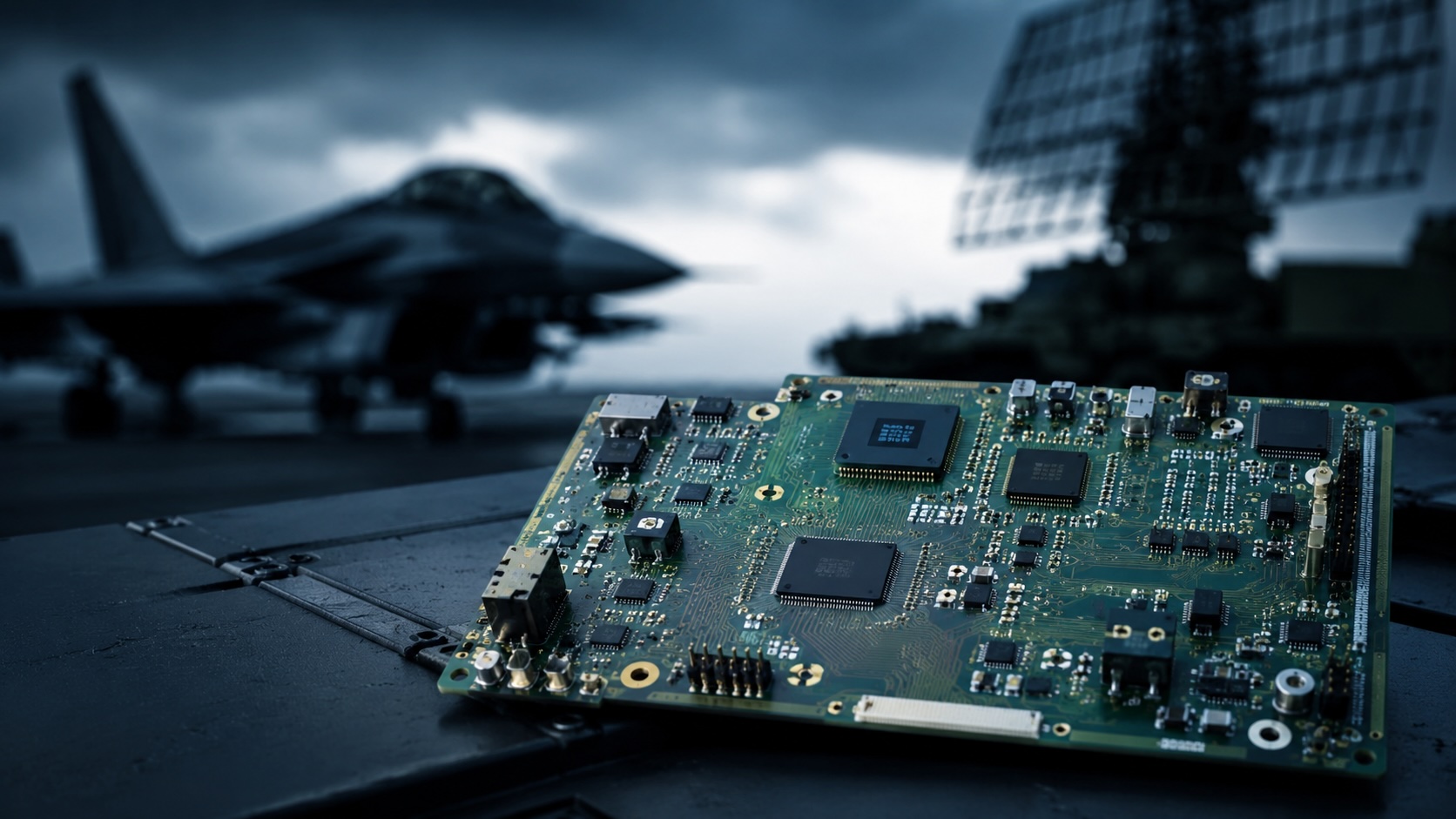
We live in troubling times. A quick glance at the headlines is enough to remind us that various regions around the world are currently experiencing active fighting and instability. Significantly increased defense spending will likely create shortages on many critical parts used in the industry.
However, as defense budgets expand, could there be another problem on the horizon? With instant obsolescence also on the rise right now, component supply issues could be set to multiply for military projects.
Defense spending is up
While the United States is by far the world’s largest spender on aerospace and defense, other countries are beginning to follow suit, largely at Trump’s insistence. Following months of pressure from the US President, Nato leaders have recently agreed to ramp up defense spending to 5% of their countries’ economic output by 2035.
The commitment involves at least 3.5% of each member state’s GDP to be spent on core defense expenditure, plus up to 1.5% on a broadly defined series of investments connected to security infrastructure.
Trump hailed the pledge as a ‘big win’, but he has also made his own efforts to increase defense spend with his ‘Big Beautiful Bill.’ The US military will receive a budget increase of $150bn under the bill, with the money used to bolster the armed forces’ shipbuilding capacity, as well as to fund Trump’s “Golden Dome” missile defense project.
Asian nations are also pouring resources into developing next-generation military capabilities, which now account for 23% of global defense spending. Indian authorities, for example, recently announced a .53% rise in its defense budget for 2025-26, while Taiwan is aiming to boost its military and defense spending to more than 3% of gross domestic product. This is up from its current 2.45%, although well short of the 10% that Trump has demanded.
Modern military projects increasingly rely on electronics
As global defense spending climbs, many nations are focused on localizing defense production to boost self-reliance and reduce foreign dependency. This is often impacted, however, by the shift towards more advanced electronics within the military sector.
Alongside the aircraft carriers and ships that we traditionally associate with defense, there is an ongoing demand for more modernized technologies such as advanced cybersecurity and drone innovations that rely on artificial intelligence capabilities. As a consequence, we can expect ever greater reliance on cutting-edge semiconductors in military projects.
Back in the 1950s, government spend was the primary driver of electronics innovation. Fast forward to today and Department of Defense spend has reduced to just 2% of the total electronics market in the US. The commercial market, particularly consumer electronics, outpaces defense in both scale and R&D spend. That means commercial customers are driving innovation in electronics and DoD design engineers often have no other option than to specify shorter lifecycle ‘commercial off the shelf’ (COTS) parts.
Instant obsolescence is on the rise
Despite the growth in advanced military electronics, there are still plenty of defense-related products with a long lifespan, often in excess of 20 years. Within this landscape, obsolescence of electronic components can potentially impact operational readiness and strategic capabilities. Not only that, it also comes with a hefty price tag.
Redesigning hardware in response to obsolescence, for example, can be a multi-million dollar effort. Component replacement can also entail considerable cost, plus downtime for testing. As governments increasingly rely on complex technologies with varying lifespans, the risks of obsolescence increase, which means the current rise in ‘instant obsolescence’ is a major red flag. According to Datalynk, approximately 35% of components that become obsolete face instant obsolescence.
This scenario, where parts become obsolete without warning and no opportunity for a Last Time Buy (LTB) began during the Covid pandemic but is now becoming increasingly common in the electronics industry. What’s more, some sources expect instant obsolescence to rise in the coming year, in line with new tariff introductions and raw material shortages.
In fact, as more tariffs hit, producing export restrictions, component manufacturers could find more and more components financially unviable. Faced with higher costs and declining demand from international buyers as companies strive to domesticate supply chains, manufacturers may opt to discontinue production entirely.
The potential for disruption is significant, particularly in high reliability and complex industries such as aerospace and defense, but also healthcare and automotive where approval and certification takes time.
How AERI can help you combat instant obsolescence
When parts become instantly unavailable, you need to take action quickly in order to limit the damage. At AERI, we can help you respond by evaluating your options.
Our thorough analysis of the market provides vital knowledge of current supply dynamics and we can get to work immediately to source hard to find components. This provides valuable time while working on a redesign or identifying viable alternatives.
For a truly proactive approach to tackling obsolescence in defense electronics, contact AERI now to facilitate future rapid procurement and maximize equipment resilience.

Robb Hammond is the founder and CEO of AERI, an independent electronic component distributor operating since 1994. He is a founding member and former committee chair of SAE AS6081, the counterfeit-avoidance standard for independent distributors adopted by the U.S. Department of Defense, and a recognized authority on counterfeit detection.
